

What You'll Learn
- Key differences between myo-inositol and D-chiro-inositol
- Why the 40:1 ratio matters physiologically
- Which form is better for PCOS, fertility, and insulin resistance
- When combining both forms makes sense
- What the clinical trials actually show
If you've been researching PCOS, you've almost certainly come across the myo-inositol vs d-chiro inositol debate. Both compounds are forms of inositol — a naturally occurring carbohydrate found in your cells — and both play important roles in hormonal health. But they're not the same thing, and they don't do the same job. Understanding the difference may help you make a more informed choice about supplementation.
This article breaks down what each form does, what the research actually shows, and why the ratio between them matters as much as the individual compounds themselves.
What Is Myo-Inositol?
Myo-inositol is the most abundant form of inositol in the human body. It acts as a secondary messenger in insulin signaling, helping cells respond to insulin more effectively. The Complete Guide to Myo-Inositol covers this in depth, but the short version: myo-inositol is involved in how your cells communicate, how follicles develop in the ovaries, and how your body manages glucose.
In people with PCOS, myo-inositol levels are often lower than they should be — particularly in ovarian follicular fluid. Multiple clinical trials have investigated how supplementation with myo-inositol may support ovarian function, menstrual regularity, and insulin sensitivity in women with PCOS.[1]
Myo-inositol is also found in foods like citrus fruits, beans, and whole grains — but typically in amounts far lower than what's been studied in clinical research.
Different Roles
Myo handles cellular signaling; DCI focuses on glycogen storage and insulin action
Ratio Matters
Excess DCI can actually harm egg quality — the 40:1 ratio mirrors natural physiology
Fertility Winner
Myo-inositol shows stronger evidence for egg quality and ovarian function
Insulin Action
DCI may offer targeted benefits for insulin resistance when used in the correct ratio
What Is D-Chiro Inositol?
D-chiro inositol (DCI) is a stereoisomer of myo-inositol — meaning it has the same chemical formula but a slightly different molecular structure. While myo-inositol is the dominant form in most tissues, d-chiro inositol is more concentrated in specific tissues, particularly liver and muscle, where it helps mediate insulin's effects on glycogen synthesis.[2]
Your body actually converts myo-inositol into d-chiro inositol through an enzyme called epimerase. In people with PCOS and insulin resistance, this conversion is often impaired — which is one reason DCI levels tend to be lower in women with PCOS.[3]
Early research on d-chiro inositol alone showed some promising effects on androgen levels and ovulation. But subsequent research complicated the picture considerably.

Myo-Inositol vs D-Chiro Inositol: What Does the Research Show?
Here's where it gets interesting. When researchers began testing high doses of d-chiro inositol on its own — particularly in ovarian tissue — they found something unexpected: too much DCI in follicle fluid was actually associated with reduced oocyte quality, not improved.[4]
This led researchers to look more carefully at the ratio between the two forms. In healthy ovarian follicular fluid, the ratio of myo-inositol to d-chiro inositol is approximately 40:1. In women with PCOS, this ratio is often disrupted — and restoring it appears to matter far more than simply maximizing either compound on its own.[5]
A 2012 clinical trial by Nordio and Proietto found that a combined 40:1 supplement (myo-inositol plus a small amount of DCI) outperformed myo-inositol alone in improving several PCOS-related markers, including hormonal balance and oocyte quality.[5] Subsequent research has continued to support the combined approach at this specific ratio.
So while myo-inositol is clearly the dominant and more widely studied form, the research doesn't support using d-chiro inositol at high doses as a standalone supplement — especially for ovarian health. The two forms appear to work best together.

Which Is Better for PCOS: Myo-Inositol or D-Chiro Inositol?
The honest answer: neither on its own. The strongest evidence for PCOS support points to the combined 40:1 ratio — 40 parts myo-inositol to 1 part d-chiro inositol.[5,6]
Here's how to think about the individual roles:
- Myo-inositol is the foundation. It supports insulin signaling, follicle development, and oocyte quality. It's the primary form in ovarian tissue and should make up the bulk of any inositol supplement.
- D-chiro inositol supports insulin-mediated glycogen synthesis in peripheral tissues. A small amount is important — but more isn't better when it comes to ovarian health.
Women who've taken high-dose DCI alone have sometimes reported worsening egg quality, which aligns with the research on the ovarian paradox. This is why the 40:1 ratio became the clinical benchmark — it mirrors what's naturally found in healthy follicular fluid.
If you want to learn more about myo-inositol's specific role in PCOS, we've covered it in detail in our guide on myo-inositol for PCOS. And for anyone thinking about the role of inositol in trying to conceive, our article on myo-inositol for fertility is worth reading too.

What About Dosage?
Most clinical research on the 40:1 combined formula has used a total daily dose of 2,000–4,000mg of myo-inositol paired with a proportionally small amount of d-chiro inositol. The standard studied dose providing the 40:1 ratio is typically 2,000mg myo-inositol with 50mg d-chiro inositol per day.[1,5]
Splitting the dose — taking half in the morning and half in the evening — may support more consistent blood levels, though individual needs vary. For a full breakdown of dosage considerations, see our myo-inositol dosage guide.
As with any supplement, we recommend consulting your healthcare provider before starting, especially if you're managing a health condition, taking medications, or trying to conceive.
The Natural Conclusion: Why Both Forms Together Make Sense
The research consistently points in one direction: myo-inositol and d-chiro inositol work as a team, not competitors. The question was never really which one is "better" — it's about having both in the right proportion.
That's the reasoning behind KINDNATURE's formulation of our Myo-Inositol & D-Chiro Inositol gummies: each daily serving delivers 2,000mg myo-inositol + 50mg d-chiro inositol — the exact 40:1 ratio supported by clinical research — alongside 400 IU Vitamin D3 and 200mcg DFE Folate.
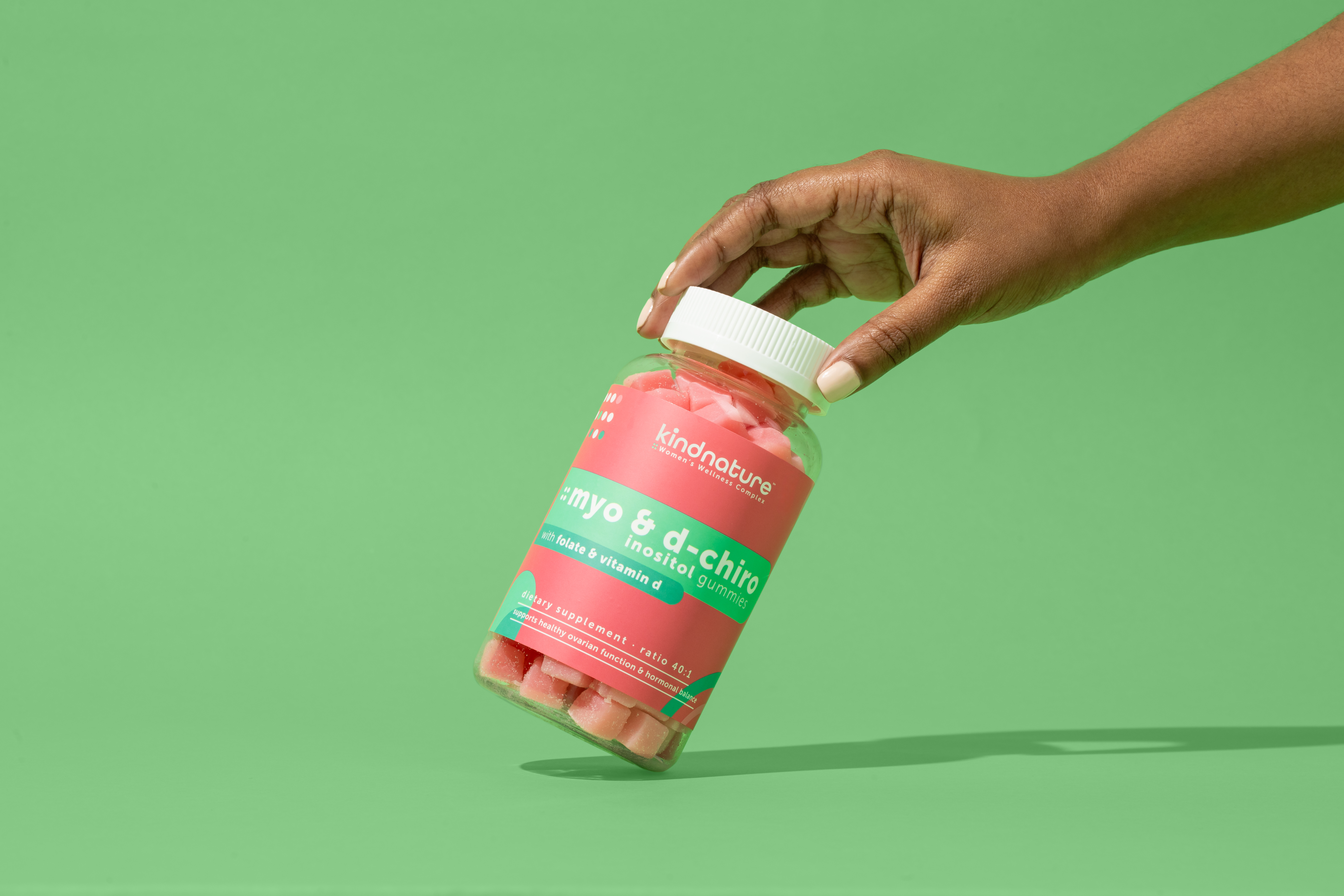
They come in a watermelon flavor, 120 gummies per bottle (30-day supply at 4 gummies/day), rated 4.2 across 385 reviews. One formula, both forms, the right ratio.
Both forms of inositol play distinct biological roles, but myo-inositol carries the stronger and broader evidence base — especially for fertility and PCOS. When using DCI, always pair it with myo-inositol in the physiological 40:1 ratio.
Frequently Asked Questions
Can I take myo-inositol and d-chiro inositol together?
Yes — and the research suggests this is the preferred approach. The body naturally maintains both forms, and supplementing at the clinical 40:1 ratio (myo-inositol to d-chiro inositol) is what's been most studied for PCOS-related support.[5]
Is d-chiro inositol better than myo-inositol for PCOS?
Not on its own. High doses of d-chiro inositol alone have been associated with reduced oocyte quality in some research.[4] Myo-inositol is the dominant form in ovarian tissue. The strongest evidence supports using both forms together at the 40:1 ratio, not DCI alone.
What is the 40:1 ratio and why does it matter?
The 40:1 ratio refers to the natural concentration of myo-inositol to d-chiro inositol found in healthy ovarian follicular fluid — approximately 40 parts myo-inositol for every 1 part d-chiro inositol. In women with PCOS, this ratio is often disrupted. Clinical research suggests supplementing at this specific ratio may support ovarian health more effectively than either form alone.[5,6]
How long does it take for inositol to work?
Most clinical trials run for 3–6 months, which is the typical timeframe used to assess outcomes like hormonal markers and menstrual cycle regularity. Individual responses vary, and it's important to work with a healthcare provider to track progress.
Is myo-inositol safe to take daily?
Myo-inositol has a strong safety profile in clinical research, with doses up to 4,000mg/day used in studies without significant adverse effects reported.[1] That said, individual circumstances vary — consult your healthcare provider before starting any new supplement regimen.
Can I get enough myo-inositol from food?
Myo-inositol is found in foods like citrus, beans, oats, and nuts, but dietary amounts are typically well below the doses studied clinically (usually 1,000–4,000mg/day). Supplementation is generally used when therapeutic doses are the goal.
References
- Unfer V, et al. Effects of inositol(s) in women with PCOS: a systematic review of randomized controlled trials. Int J Endocrinol. 2016;2016:1849162. PubMed
- Larner J. D-chiro-inositol — its functional role in insulin action and its deficit in insulin resistance. Int J Exp Diabetes Res. 2002;3(1):47–60. PubMed
- Croze ML, Soulage CO. Potential role and therapeutic interests of myo-inositol in metabolic diseases. Biochimie. 2013;95(10):1811–27. PubMed
- Colazingari S, et al. The combined therapy myo-inositol plus d-chiro-inositol, rather than d-chiro-inositol, is able to improve IVF outcomes. J Ovarian Res. 2013;6(1):78. PubMed
- Nordio M, Proietto E. The rationale of the myo-inositol and D-chiro-inositol combined treatment for polycystic ovary syndrome. J Clin Pharmacol. 2012;52(7):1041–51. PubMed
- Pkhaladze L, et al. Myo-inositol is more effective than d-chiro-inositol in a rat model of PCOS. Nutrients. 2020;12(4):1098. PubMed
This article is for informational purposes only and is not intended as medical advice. As with any supplement, we recommend consulting your healthcare provider before starting a new regimen, especially if you are managing a health condition or taking medications.


